
Some gentle but probing questions for brethren who think the Sacred Name has always been properly pronounced Jehovah
Thou hast magnified Thy Word above all Thy Name.
1 Is the Name only vowelled to pronounce 'Jehovah' in the Masoretic text? If not, why not?
(There are in fact 6 variant vowellings of the Name.)
2 Whenever the Sacred Name is apposed to the title Adonai, it is vowelled for & only pronounced as Elohim, why?
(Why too do no Qere-Ketiv circules ever appear here too?)

3 When prefixed by a preposition, why is the vowelling of the sacred Name always, only consistent with Adonai, and not with Jehovah?
This applies to Li, Ci, Bi, and Min as well as the conjunction vaw.

4 If the meaning of Jehovah is a composite name of three tenses of the verb hayah היה, to be, why is not even one of them actually transcribed accurately?
5 Hebrew only contains only two tenses, perfect and imperfect, or preterite and future. There are many names based on verbs, are there any other examples of two tenses of any one verb in the same name, let alone three?
Is not the Divine Name unique, but neither garbled nor confected? Are there any other examples of a Hebrew name containing a compound of a verb and its participle in the same tense, as the name Jehovah purports to be?
6 The Hebrew for he bows down, יִשְׁתַּחֲוֶהּ (eg Esth.3.2),after contraction after a vaw conjunction is pronounced with a final shuruq vaw, the final heh being excised, וַיִּשְׁתַּחוּ (eg Gen.18.2). If the Sacred Name, whatever its true vowelling, was suffixed to a name, would you ever expect its terminal heh to remain and penultimate vaw to remain unchanged?
7 Why is YHVH abbreviated to qamatz yod Yah,יָהּ, if the first syllable is properly sheva yod, יְה?
8 Does the suffix Yah to theophoric names come from the last syllable of HaShem or the first? How does sheva yod יְה or hateph segol yod יֱה become qamatz yod,יָהּ, in an abbreviated word? Can you provide any other example of this happening?
9 The frequent expression YHVH Zevaot, יְהוָה צְבָאוֹת, the LORD of Hosts, if Jehovah means 'He was, is and shall be', or something similar, implies His identity with the Heavenly Hosts, not dominion or creation of them, does it not? Does this not open the gate to angelolatry or pantheism?
10 In the light of the standard answers or silence to these questions, are you not embarrassed to advocate a post hoc justification of taking the vowels of the universally acknowledged rabbinic practice of the Qere reading of Adonai, being superimposed on the unpronounced consonants (to both Rabbinic and most Karaite Jews) of the Sacred Name (both with and without the cholam)?
More detailed examination of the questions (and here, local)
The TBS position paper.
Nehemia Gordon, a Karaite Jew, takes the same basic, flawed position.
Error correction welcome.
Background.
It is common Rabbinic practice now to superstitiously avoid the pronunciation of the Name to hedge the third (not second) commandment.
It is widely acknowledged that the Masoretic text vowels it to enable the reading of the word 'Adonai' or 'Elohim', which derives from an excessive caution of breaking the third commandment and is inaccurate.
To honour the Name and the commandment, the text should at least be unvowelled, as it has been in the Koren text.
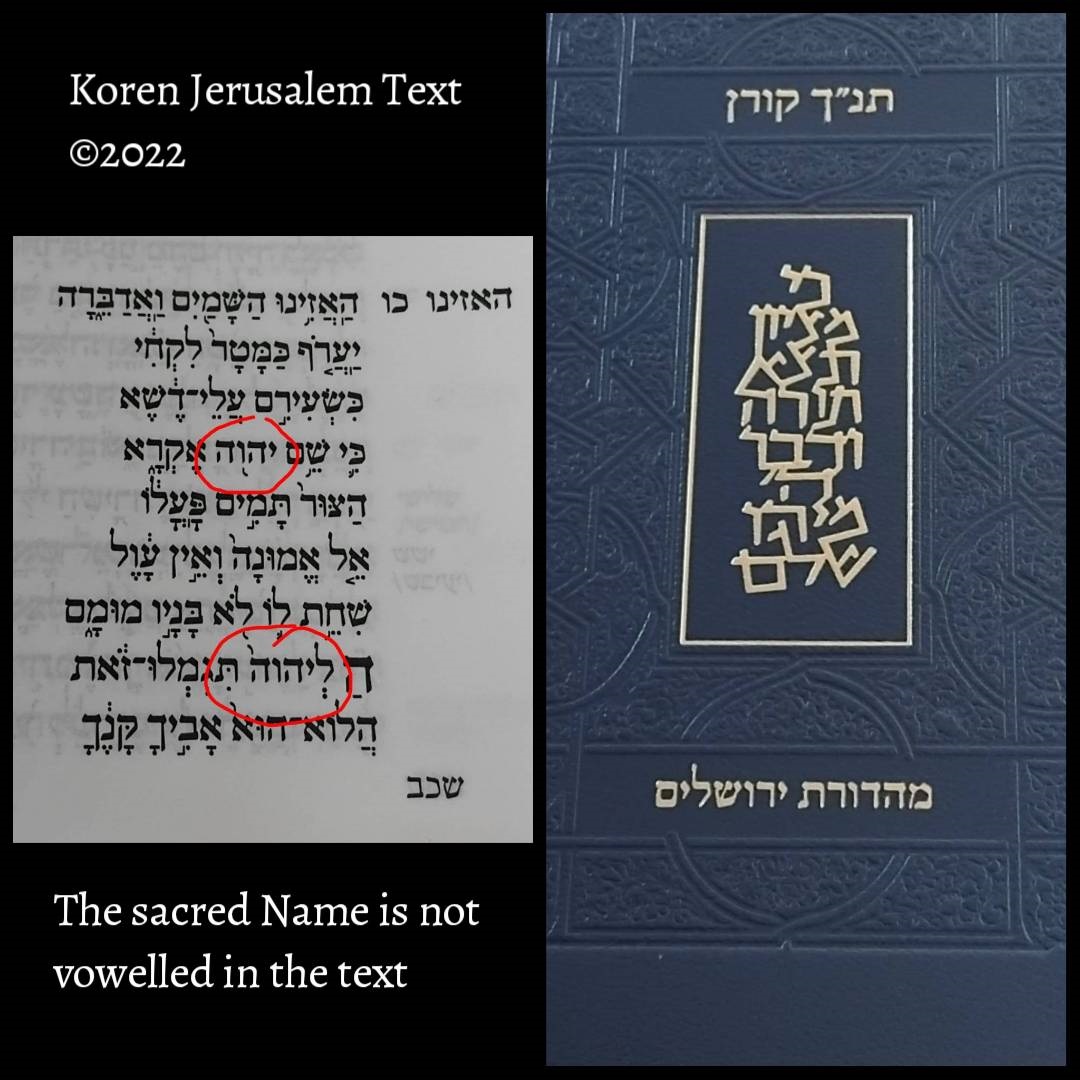
Josephus writes (Antiq.2.12.4)
'Whereupon God declared to him [Moses] His holy Name, which had never
been discovered to men before; concerning which it is not lawful for me
to say any more.' It is clear from many passages in the Tenach, that
the Name's letters and pronunciation were known from the beginning (Gen.4.1,26),
and that the Sacred Name was widely and properly used among believers (to give just one of 100s of examples, Ruth 3.12) till these unlawful scruples stifled the worshipful employment of the great Name.
Even chapter headings in the Hebrew Bible (the Tenach) avoid combinations like יה to avoid invoking the Divine Name thoughtlessly and are substituted with other letters with the same numerical value. Despite this, the Divine Name is a common component of personal names, especially but not exclusively, after the Exodus (for an example of an exception see Issachar's grandson Rephaiah). Israel's PM's valiant brother, the leader of the Entebbe raid, had a near palindromic example, Yehonatan Natanyahu.
Even chapter headings in the Hebrew Bible (the Tenach) avoid combinations like יה to avoid invoking the Divine Name thoughtlessly and are substituted with other letters with the same numerical value. Despite this, the Divine Name is a common component of personal names, especially but not exclusively, after the Exodus (for an example of an exception see Issachar's grandson Rephaiah). Israel's PM's valiant brother, the leader of the Entebbe raid, had a near palindromic example, Yehonatan Natanyahu.
The Sacred Name - its meaning.
Other reflections on the Saviour's use of the Divine Name, here and the Divine Name in Esther.
Weingreen's treasure of a grammar much more readable than critical Gesenius.
Davidson's pearl.
Last updated 25/12/25
Created 11/25
Home
Theology Ministry of God's Word
Evolution Rome EU
Islam / The Satanic verses
The land of Israel
Christian Antisemitism
Writings for Rabbinics
Evangelical Apostasy